
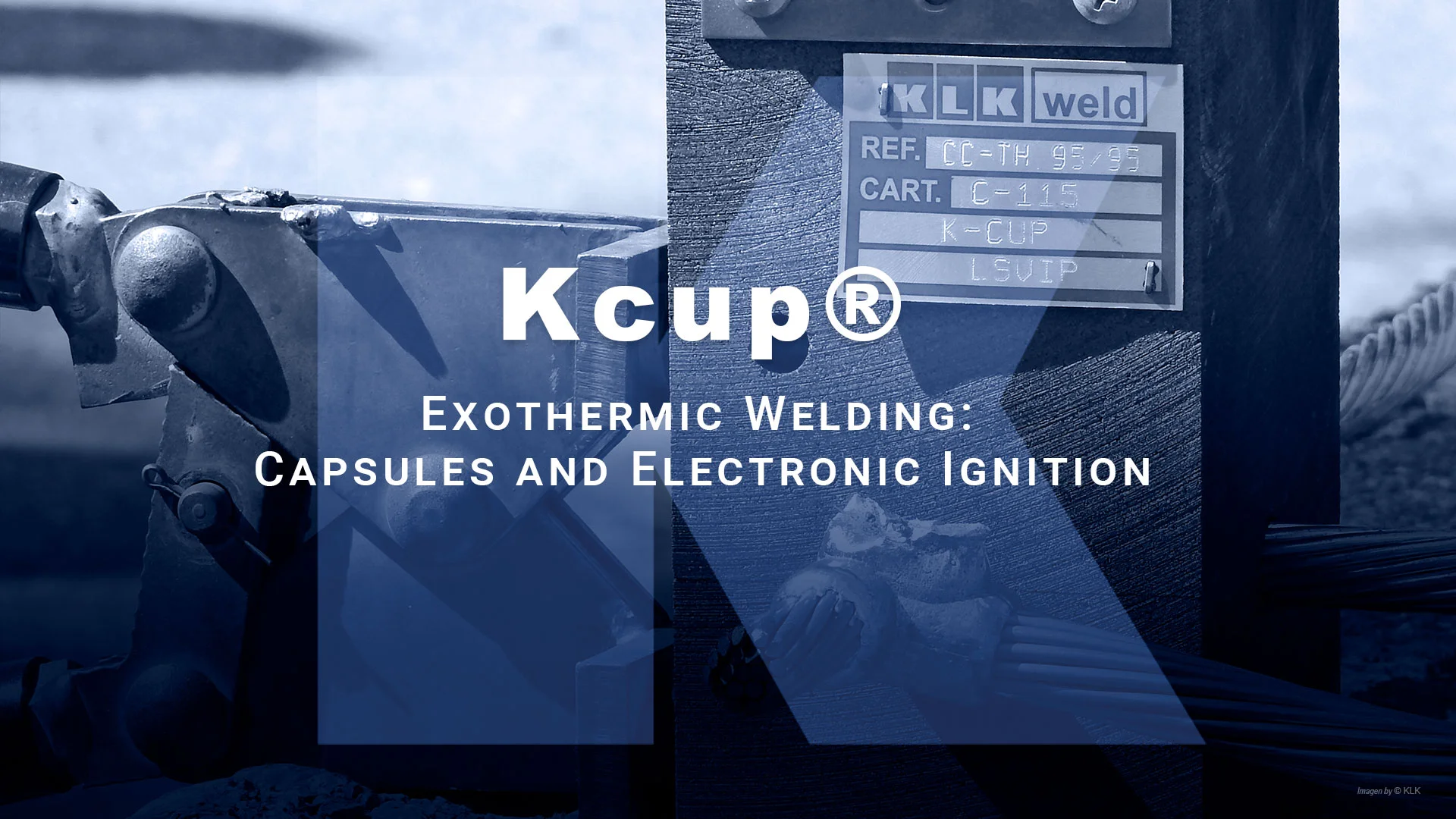
Kcup® Exothermic Welding: Faster and Safer
In electrical installations where there is no margin for error—grounding systems, substations, industrial facilities, power generation, and railway environments—the exothermic weld remains the benchmark for achieving permanent electrical connections with low resistance and high reliability.

Railway Maintenance Installation | Kcup® by KLK
With Kcup®, KLK takes a step further: it maintains the same metallurgical principle of copper aluminothermic welding, while simplifying execution through a encapsulated format and an electronic ignition device designed to operate without the need for ignition powder.
The result is a solution engineered for real-world field work: faster execution, less handling, and greater operational safety.
If you are looking for a specialist in all types of exothermic welding for copper-to-copper or copper-to-steel connections, this guide provides clear, technical context.
What is Kcup® in Exothermic Welding?
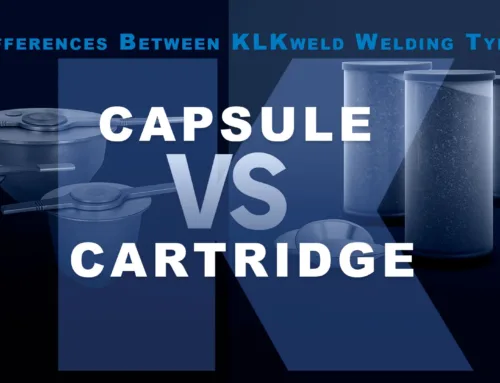
Kcup® is a new exothermic welding procedure developed by KLK, based on the same fundamental principle as the traditional process (the aluminothermic reaction), but with one key difference: the aluminothermic mixture is supplied in ready-to-use capsules. Instead of opening containers, dosing, pouring, and building up material layers, the operator simply places the capsule into the mold crucible and executes the process with a much more direct workflow.
This approach reduces steps, standardizes the charge, and minimizes preparation errors—especially relevant when performing specialized welds in the field, under tight schedules and variable environmental conditions.
How Aluminothermic Welding Works
(Technical Basis)
Copper exothermic welding is based on the reduction reaction of copper oxide by aluminum. This reaction generates molten copper and alumina at temperatures exceeding 2,000 °C. In this state, the molten metal flows through the graphite mold and forms a metallurgical bond between the conductors positioned inside it (for example, copper-to-copper or copper-to-steel).
In practical terms, this is not a “mechanical joint” or a simple pressure contact. It is a permanent connection that, when properly executed, delivers long-term electrical stability throughout the service life of the installation—even in corrosive environments or under high thermal stress.
What Changes with Kcup® Compared to the Traditional Process
No More Mixing of Reactive Components:
In the traditional system, preparation typically involves tasks such as opening a dual-compartment container, placing a steel disk in the crucible, pouring the aluminothermic mixture, adding ignition powder (reserving part of it), installing an ignition fuse, and completing the ignition stack-up.
With Kcup®, simplification is straightforward:
- One key action: place the capsule into the mold crucible.
- No opening or pouring of mixtures: material handling is avoided, reducing exposure and mess.
- Fewer steps, less variability: a more repeatable process helps maintain quality in field conditions.
- Improved operational efficiency: less preparation time and fewer auxiliary components around the mold.
This type of improvement has a particularly strong impact on grounding applications and installations with a high number of repetitive connections, where productivity and consistency make a real difference.

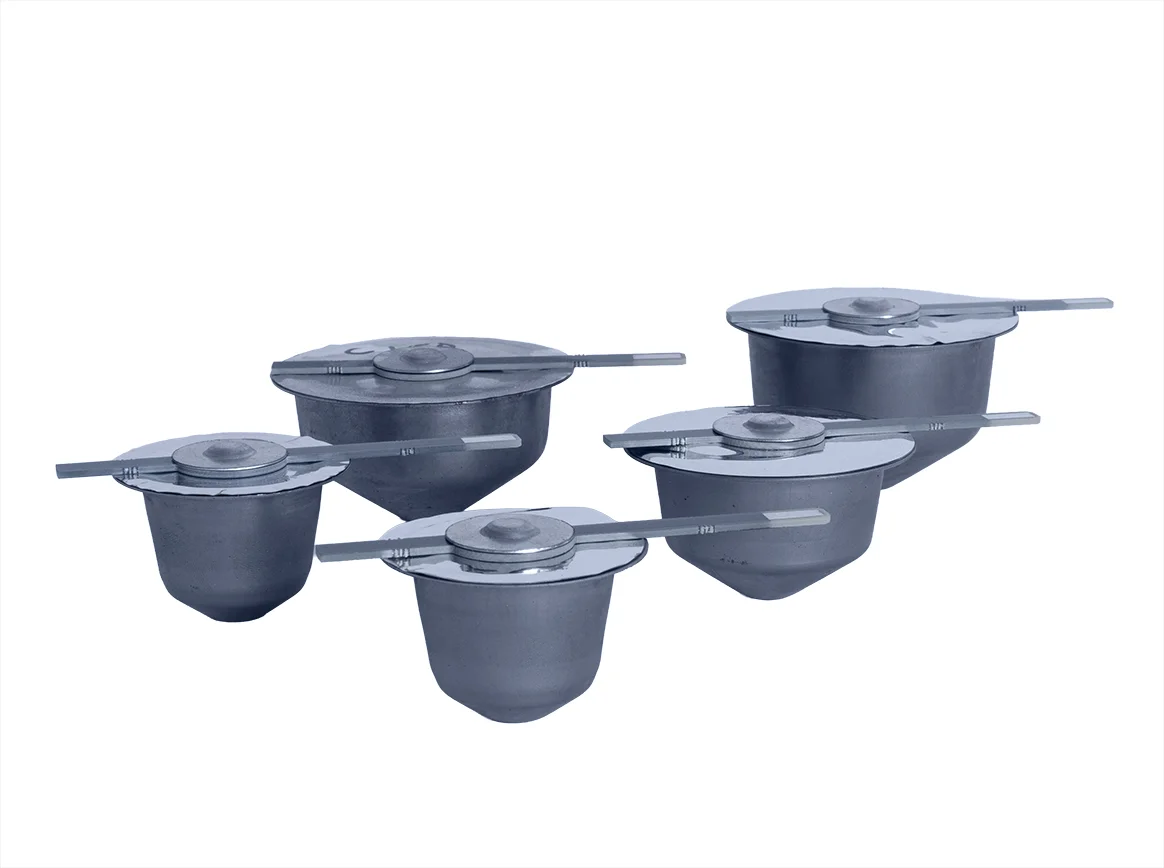
Electronic Ignition Without Ignition Powder:
Kcup® is complemented by the Electronic Ignition Device, capable of initiating the reaction even when no ignition powder is present in the capsule. This shifts the approach in two key areas:
- Safety: by eliminating ignition powder from the process, the risks associated with handling highly flammable material are reduced.
- Logistics and transportation: material management is simplified—particularly important for mobile crews or jobsite work.
In exothermic welding applications, electronic ignition also contributes to a more consistent execution rhythm: fewer manual micro-steps and greater control over the procedure.
Technical Benefits for Grounding and Electrical Connections:
If your objective is to ensure a reliable connection, the true value of exothermic welding lies in the final result. Kcup® reinforces that value at the operational level:
- Permanent connections: metallurgical bonds suitable for grounding grids and critical taps.
- Lower contact resistance: essential for electrical safety and fault current performance.
- Repeatability: reduced variability in preparation helps standardize results across different crews.
- Productivity: less preparation and handling translates into more welds per shift.
- Operational safety: no ignition powder in the process and reduced handling of reactive materials.
Typical Applications of Kcup®
Kcup® is designed for environments where professional grounding and electrical connections must be durable and reliable.
Typical application scenarios include:
- Industrial installations: bonding of conductors, down conductors, and taps in equipotential grounding networks.
- Energy and renewables: joints in grounding systems, metallic structures, and electrical continuity paths.
- Infrastructure and construction: projects with a high volume of connections and a need for standardization.
- Demanding environments: humidity, corrosion, or conditions where maximum connection stability is required.
Best Practices for Reliable Exothermic Welding
Although Kcup® simplifies the procedure, final quality still depends on fundamentals that do not change.
Operational recommendations:
- Conductor preparation: proper cleaning and fitting to avoid looseness or contamination.
- Mold condition: check cavities, ensure proper closure, and confirm the absence of cracks or excessive wear.
- Positioning: conductors must be centered and stabilized to ensure uniform metal flow.
- Work sequence: follow the defined technical procedure (no “shortcuts”) to maintain repeatability.
- Final inspection: visual verification and technical assessment according to the type of connection and applicable standards.
If you need support to define the procedure or select consumables and molds, KLK’s technical team can help you standardize the solution according to your specific application.
Frequently Asked Questions About Kcup® Exothermic Welding
Conclusion
Kcup® combines the core advantages of exothermic welding—a permanent, robust, and stable bond—with a genuine leap in usability: capsules that eliminate unnecessary steps and electronic ignition that enhances safety and operational control. If you are looking for specialized welding solutions for critical grounding connections, Kcup® is ready to become your go-to solution.
Do you have questions about your application or need help selecting the right system? Contact our technical team, and we will help you define the most suitable Kcup® solution based on your conductor type, connection, and installation environment.
More Technical Documentation About Kcup®
KLK Electro materiales slu
Mail | Web | Teléfono | Chatbot | Social Media
Need help?